
Wastewater Collection and Treatment

Halton Region's responsibility for treatment of wastewater
Halton Region is responsible for the treatment and management of wastewater. The Region owns and operates 7 Wastewater Treatment Plants. These treatment plants deal with 232,000 cubic metres of wastewater every day.
Locations of Halton Region's Wastewater Treatment Plants
The wastewater treatment process
Wastewater arrives at one of Halton Region’s Plant’s after travelling through many kilometres of sewer pipes and pumpstations. It first goes through a pretreatment phase to remove any debris (i.e. rags, large plastic, heavy granular material).
Primary settling tanks then provide an efficient process for the removal of solids that sink to the bottom. The water containing suspended solids (small particles that did not settle out) undergoes secondary treatment where microorganisms such as aerobic bacteria “eat” the suspended solids and create a “floc” that can more easily settle to the bottom of the tanks. Final settling tanks settle this floc which is then pumped back to the primary treatment tanks to settle with the primary solids.
These solids together are pumped to the digesters where they are undergo treatment to be turned into “biosolids.” Biosolids are a clean and safe organic product, rich in nutrients, that are beneficially reused by the agricultural community for healthy crop production. Disinfection of the effluent water is the final part of the treatment process.
Halton Region uses ultraviolet radiation to disinfect the water inactivating disease causing bacteria and viruses.
Wastewater and stormwater performance reporting
The Ministry of the Environment, Conservation and Parks modernized its approach to the Environmental Compliance Approval application process, creating the Consolidated Linear Infrastructure Environmental Compliance Approval. The reports below meet the requirements of this process.
Wastewater Collection Systems
Wastewater Treatment
Stormwater Management System
Sanitary sewer overflows and the wastewater collection system
About sanitary sewer overflows
A sanitary sewer overflow is an emergency mechanism that activates when too much water enters the wastewater system. This can occur during heavy rain, fast snowmelt, or when equipment fails. To protect the system and prevent backups, the mechanism automatically releases the extra water at overflow relief points called outfalls. When this happens, untreated or partly treated sewage can enter the environment.
Sanitary sewer overflow outfalls are strategically located and designed to:
- protect homes and businesses from basement flooding through sewer backups
- maintain the integrity of the wastewater system
- prevent potential damage to the wastewater treatment plants
Signage at sanitary sewer overflow outfalls
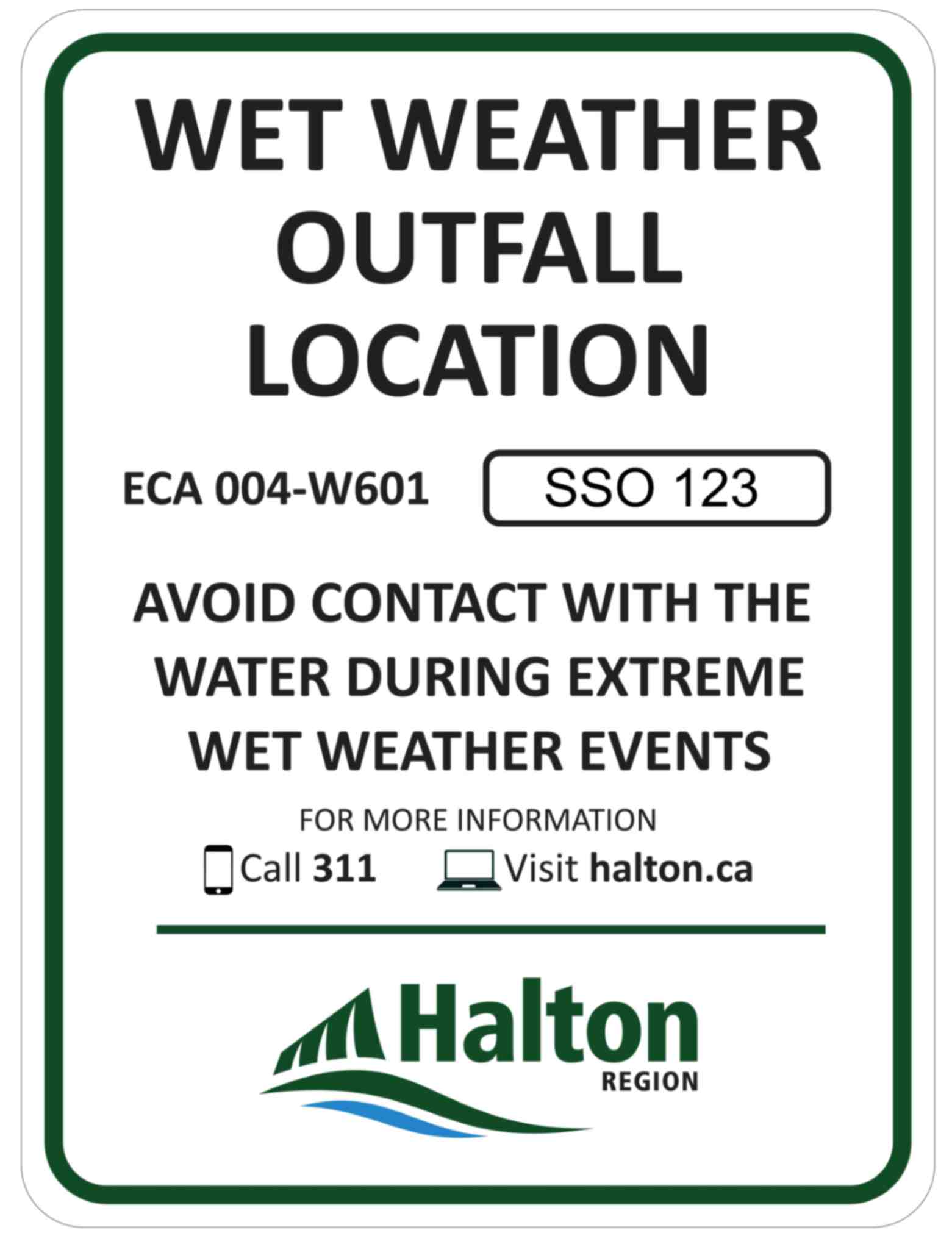
Halton Region is committed to maintaining a safe, reliable, and resilient wastewater collection system. As part of this commitment, signage appears at publicly accessible sanitary sewer overflow outfall locations.
The purpose of the signs is to:
- identify the location of nearby outfall
- inform the public to avoid contact with the water during extreme wet weather, when overflows are more likely to occur
- advise how to learn more
Sewage contains illness-causing microorganisms such as bacteria, viruses, and parasites. It can also contain other pollutants. Overflow events are rare, but you should avoid contact with water at these locations during and after extreme wet weather.
Sanitary sewer overflow outfall locations
Halton Region maintains 76 overflow outfall locations across Burlington, Oakville, Milton, and Halton Hills. These are classified by exit point:
- Pumping Station Overflows (marked "PSO" on the map) release at pumping stations, such as Armstrong Avenue (Georgetown), Navy Street (Oakville), and Laurier Avenue (Milton).
- Sanitary System Overflows (marked "SSO" on the map) release at the collection system, such as Roseland Creek (Burlington), Gairloch Gardens (Oakville), and Agnes Street (Acton).
Each location includes:
- overflow ID
- name of the facility associated with the overflow outfall; for example, the wastewater pumping station (abbreviated as "WWPS")
- receiving waterbody (such as Lake Ontario, the Credit River, or Hamilton Harbour)
Questions and answers
What is the purpose of the sign?
The sign indicates that a sanitary sewer overflow outfall is located nearby.
Do all overflows contain sewage?
No. In Halton, wastewater from household plumbing is collected by the sanitary sewer system. Storm sewers are a separate system; they carry surface runoff, such as rainwater or snowmelt.
Some outfalls only release stormwater, and do not contain sanitary sewage. There are no signs at those locations.
How often do sanitary sewer overflows happen?
Sanitary sewer overflows are rare in Halton. They are typically weather-related and unpredictable.
For the latest summary of past overflow events, check the Wastewater Collection Systems report.
Arranging wastewater treatment plant tours
Wastewater treatment plant tours can be arranged by contacting Access Halton for the facility you would like to see. You will find location information on the interactive map, above. Facilities under construction will not be available for tours.
Tour participants should wear casual clothing and comfortable shoes or boots.
Contact
To learn more, or to get in touch with any treatment plant:
- Call 311 (within Halton Region)
- 905-825-6000
- Toll Free: 1-866-442-5866
- TTY: 905-827-9833
- Email: accesshalton@halton.ca