
Online Consultation: Trafalgar Road Municipal Class Environmental Assessment Study
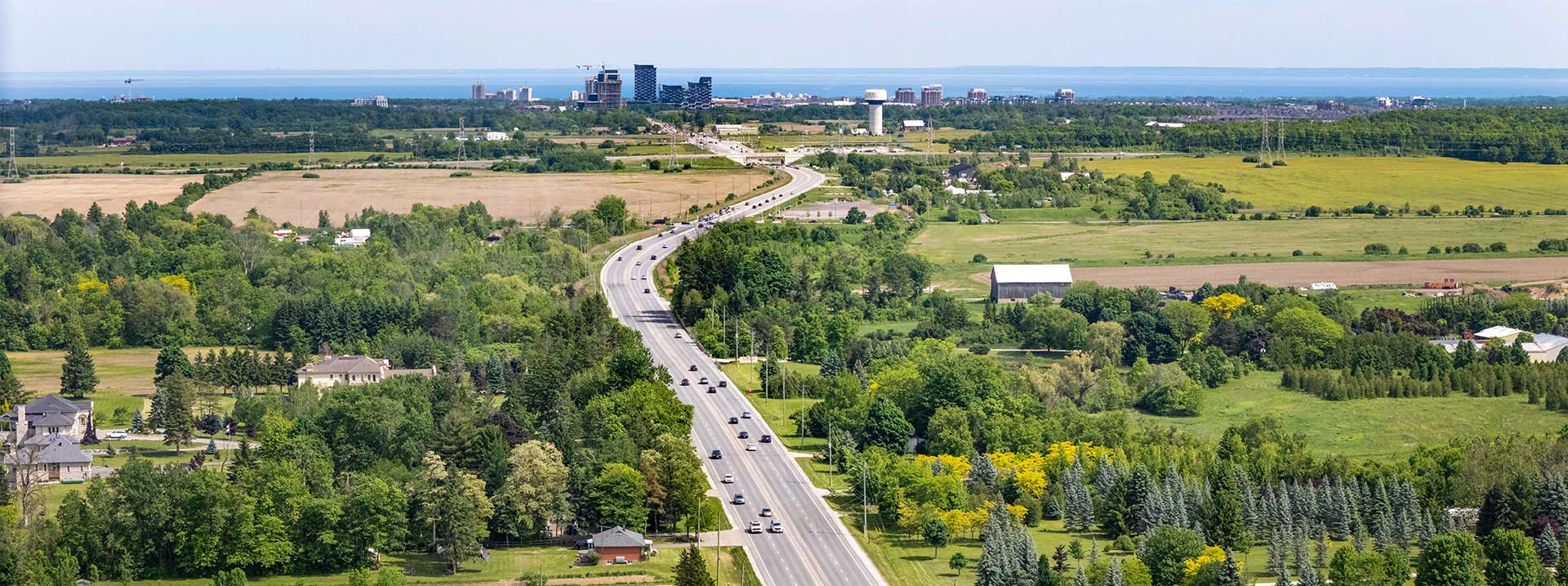
About the project
Study overview
To improve Halton’s road network and address changing travel demand, the Region is considering the following:
- widening the roadway;
- active transportation;
- infrastructure to support public transit;
- improved intersections;
- overall traffic operations and safety; and
- the impact of improvements on the social, cultural and natural environments.
An online consultation for Public Information Centre #1 took place between . The presentation is available to view on the MCEA project webpage.
Study area
Public Information Centre materials
An online Public Information Centre took place between . To learn about the study findings so far, you can watch or listen to the videos below. You can also access a PDF copy of the presentation (PDF file).
Introduction
Development of Preliminary Design Alternatives
Preliminary Preferred Design
Next steps
Share your feedback
To find background information or download copies of notices and reports:
Contact us to join the study mailing list or if you need an alternate format:
What we heard
From , Halton Region received more than 80 survey responses as part of the second online Public Information Centre (PIC) for the Trafalgar Road Municipal Class Environmental Assessment (MCEA) Study.
Thank you to everyone who provided valuable input on the study!
We have summarized what we heard and have provided additional information below to address common themes raised. We invite you to review the information and contact the project team if you have any follow up questions or comments.
How is the study considering adjacent Secondary Plans?
In developing the preliminary preferred design, including proposed future intersection locations, we considered the following Secondary Plans within the study area:
- Premier Gateway Phase 1B (Town Halton Hills) (external link)
- Trafalgar and Agerton Secondary Plans (Town of Milton) (external link)
- North Oakville East Secondary Plan (Town of Oakville) (external link)
What type of active transportation facilities are proposed along the corridor?
A combination of multi-use paths, cycle tracks, and sidewalks are proposed along Trafalgar Road, from Highway 407 to Steeles Avenue (Regional Road 8). All proposed active transportation facilities will be physically separated from vehicle lanes and located between the curb and property line. For more information about the specific facilities in each section of the corridor, please refer to Video 3 - Preliminary Preferred Design in the Public Information Centre materials.
What active transportation improvements have been considered at intersections?
Safety remains our top priority for all transportation improvements. The preliminary preferred design for the Trafalgar Road corridor is intended to improve safety and accessibility for all modes of travel, and to create space for pedestrians, cyclists and motorists. The preliminary preferred design includes protected intersections, including features such as set-back crossings, to improve visibility for turning vehicles and help reduce potential conflicts. All intersections will also include pavement markings and signage to clearly delineate pedestrian and cyclist crossing locations.
How is transit being considered as part of this study?
Trafalgar Road is identified as a future Transit Priority Corridor in the Integrated Master Plan, and the preliminary preferred design includes the protection for transit supportive infrastructure, such as potential future High Occupancy Vehicle (HOV) lanes. For more information, visit the Integrated Master Plan webpage.
Has the Region considered replacing signalized intersections with roundabouts?
Yes, a detailed transportation assessment was conducted to evaluate existing and future transportation conditions and needs throughout the corridor. The assessment examined all intersections in the study area, considering both traffic signals and roundabouts as potential traffic control types. Traffic signals were identified as the preferred option at each location.
Does the Region intend to add right-turn lanes at intersections?
The preliminary preferred design includes exclusive right-turn lanes at intersections, where required. For more information about the specific designs at intersections, please refer to Video 3 in the Public Information Centre materials.
How are property impacts being considered?
Minimizing impacts to surrounding properties is a key design consideration. Trafalgar Road is proposed to be widened equally on both sides of the centreline of the existing road, except in certain circumstances where the road is realigned to the east or west to mitigate impacts to sensitive features, such as the Redhill Church Cemetery and Sixteen Mile Creek. In some areas, additional property may be required to accommodate the proposed right-of-way. These requirements are illustrated by the red dashed line (labelled as the proposed right-of-way) in the preliminary preferred plan shown in Video 3 – Preliminary Preferred Design in the Public Information Centre materials. The property requirements will be further refined through the detailed design phase that will follow the completion of this study.
How are noise and air quality impacts being considered?
Noise and air quality assessments are underway to evaluate and predict how the proposed road changes will affect noise levels and air quality. The noise study will determine whether future sound levels will exceed the Region’s established thresholds and determine if mitigation measures, such as noise walls, are warranted. The findings from both the noise and air quality assessments will be documented in the Environmental Study Report, which will be published at the completion of the study.
How is access to properties and businesses along Trafalgar Road being considered?
Access to and from the corridor will follow Halton Region's Access Management Guideline (January 2015) (PDF) to maintain a high level of service for travel along the corridor, while providing access to adjacent properties and businesses. A continuous raised centre median is proposed with signalized intersections at all road connections.
What is being done to address speeding in the corridor?
Speed limits within the Regional Road system, including Trafalgar Road, are reviewed on an annual basis so that they are appropriate for current conditions. Concerns related to speeding and requests for additional enforcement can be reported through the Halton Regional Police Services’ Road Watch program (external link).
Has the Region considered restricting trucks in the corridor?
Truck restrictions are not being proposed as part of this study. The Regional road system connects Halton’s rural and urban centres while providing connections to the provincial highway system and the local road network. All Regional roads are designed to support all modes of travel, including trucks, with some seasonal restrictions. For example, Regional roads are designed to support the weight and size of transport trucks and accommodate turning movements at intersections.
What are the next steps for implementation?
This MCEA Study is anticipated to be completed in . Following the completion of this MCEA, the project will continue into the Detailed Design phase, followed by the Construction phase.
Next steps and anticipated timing
Phase 1: Problems and Opportunities
Notice of Commencement (April 2024)
Phase 2: Alternative Solutions
Public Information Centre #1 – September 2024
Phase 3: Alternative Design Concepts
Public Information Centre #2 – February 2026
Phase 4: Environmental Study Report
Publish Environmental Study Report for a 30-day review period
This study is being conducted in accordance with the planning and design process for Schedule C projects as outlined in the Municipal Class Environmental Assessment process (external link) (October 2000, as amended 2007, 2011, 2015, 2023 and 2024), which is approved under the Ontario Environmental Assessment Act, RSO. 1990.