
Road Safety

Building safer roads for everyone
How we make Regional roads safer
Road safety is a shared responsibility. Whether you’re driving to work, walking to school, cycling through your neighbourhood, rolling to your destination or taking transit, everyone should be able to travel safely.
At Halton Region, road safety is built into how we plan, design, operate and maintain Regional roads. We look at how people use our roads, identify safety concerns and make improvements that help reduce the risk of collisions.
Road safety goes beyond signs and traffic signals. Our work includes:
- Safer roads and intersections – using traffic data, collision history and engineering analysis to identify and address safety concerns.
- Safer ways to walk and cycle – providing infrastructure that supports pedestrians, cyclists and other road users.
- Smarter traffic management – using traffic signals, monitoring systems and other technologies to help manage traffic safely and efficiently.
- Education and awareness – helping road users understand the rules of the road and make safer choices.
- Working together – partnering with local municipalities, police services and other agencies to address road safety across Halton.
Comprehensive Road Safety Action Plan (CROSAP)
Bicycle safety
Cyclists are among the most vulnerable road users. Under Ontario's Highway Traffic Act (external link), bicycles are considered vehicles, which means cyclists have the same rights and responsibilities as motorists.
Halton Region supports cycling through investments in bike lanes, multi-use trails, crossrides and educational programs that help cyclists and motorists safely share the road.
Halton Region participates in the Share the Road program (external link) to help increase awareness and improve safety between motorists and cyclists. Share the Road signs are typically installed along:
- Popular cycling routes
- Recreational and scenic destinations
- Connections to municipal cycling networks
- Roads with suitable pavement conditions
- Routes with lower truck volumes
- Roads with appropriate operating speeds
Creating safe and connected transportation options is an important part of how Halton Region plans and maintains its road network. When designing new roads and rehabilitating existing ones, we evaluate opportunities to integrate on-road cycling facilities and multi-use paths that support active transportation. While these facilities are incorporated into Regional infrastructure projects, ongoing maintenance of multi-use paths and trails is managed by the local municipalities.
Crossrides are designated crossings that allow cyclists to remain on their bicycle while crossing a road at specific intersections and trail connections. Special pavement markings and signals help guide cyclists and pedestrians across intersections safely.
Crossride tips for cyclists
- Cyclist must depress the button in order receive the bicycle green signal.
- When the bicycle signal is green, ride carefully across the intersection within the crossride, watching for left- and right-turning vehicles;
- Be sure to travel at a speed that allows you to stop quickly if a vehicle makes a sudden turn;
- Obey all traffic signs and signals; and
- Don’t pass other cyclists within the crossride. When passing pedestrians, ring your bell and pass carefully.
Crossride tips for drivers
- When making a turn, be extra careful about cyclists and pedestrians who are crossing the intersection;
- Yield to cyclists and pedestrians who enter the intersection; and
- Obey all traffic signs and signals.
Crossride tips for pedestrians
- Cross at the marked crosswalk and watch for vehicles.
- Avoid using electronic devices, texting, etc. while crossing the road; and
- Obey all traffic signs and signals.
Here are a few simple steps to help make cycling safer for everyone.
- Wear a helmet – a properly fitted helmet helps protect you in a collision
- Be visible – use lights and wear bright or reflective clothing, especially early in the morning and at night
- Follow the rules – obey traffic signals and signs, and ride in the same direction as traffic
- What for turning vehicles – Be aware of blind spots and make eye contact with drivers when possible
- Give space – drivers should allow at least 1 metre when passing cyclings
Roundabouts
Roundabouts are designed to keep traffic moving while improving safety for everyone using the intersection. Vehicles travel at lower speeds and move in the same direction around a central island, reducing the number and severity of potential conflict points compared with many traditional intersections.
Benefits of roundabouts
- Safer intersections
Lower vehicle speeds and fewer conflict points can reduce the likelihood of severe collisions. - Smoother traffic flow
Vehicles can enter when there is a safe gap rather than waiting for a traffic signal to change, helping reduce unnecessary stops and delays. - Less stopping and idling
Keeping vehicles moving can reduce unnecessary idling, fuel consumption and vehicle emissions. - Designed for all road users
Roundabouts include features to help accommodate pedestrians, cyclists and drivers while keeping their movements predictable.Know before you go - How to use a roundabout
Roundabout locations
How to use a roundabout
- As you approach the roundabout, slow down and watch for pedestrians or cyclists at the entrance of the roundabout.
- Look for signage and choose the lane corresponding to your exit.
- Use the left lane to turn left or to go straight.
- Use the right lane to turn right or to go straight.
- Visual checks: Do visual checks of all vehicles already in the roundabout and those waiting to enter (including cyclists).
- Look left: Traffic in the roundabout has the right-of-way. When preparing to enter the roundabout, pay special attention to the vehicles to your left. Adjust your speed or stop at the yield sign if necessary.
- Adequate gap: Watch for a safe opportunity to enter the roundabout. Enter when there is an adequate gap in the circulating traffic flow. Don't enter directly beside another vehicle already in the roundabout, as they may be exiting at the next exit.
- Travel counter-clockwise: Once in the roundabout, always keep to the right of the central island and travel in a counter-clockwise direction.
- Keep moving: Once you are in the roundabout, do not stop except to avoid a collision; you have the right-of-way over entering traffic. Do not change lanes while in the roundabout.
- Follow the advisory speed: Reduce your speed before entering the roundabout and travel at a safe speed consistent with the advisory speed posted on the approach. Adjust your speed based on traffic, weather and road conditions.
- Missed your exit? Continue travelling around the roundabout until you reach your intended exit again. Do not stop, reverse or make sudden lane changes. Exit when it is safe to do so, while following lane markings and signs.
- Stay in your lane: Follow the lane markings and avoid changing lanes within the roundabout.
- Watch for other road users: Be aware of vehicles, cyclists and pedestrians, particularly when approaching an exit.
- Maintain your lane: Stay to the left if you entered from the left lane, or stay to the right if you entered from the right lane.
- Maintain your position: Maintain your position relative to other vehicles.
- Signal intent to exit: Once you have passed the exit before the one you are taking, use your right-turn signal and watch for pedestrians.
- Left lane exit: If exiting from the left lane, watch out for vehicles on the right that continue to circulate around the roundabout.
- If you see an emergency vehicle approaching, do not stop inside the roundabout.
- If you have not yet entered the roundabout, pull to the right and let the emergency vehicles pass you.
- If you are in the roundabout, exit as normal, then pull to the right and let the emergency vehicle pass you.
- Allow extra room alongside large vehicles (trucks and buses).
- Large vehicles may have to swing wide on the approach or within the roundabout.
- Prior to entering the roundabout, the vehicle may need to occupy both lanes.
- Give them plenty of room.
- Ride as if you were driving a car.
- Merge into the travel lane before the bike lane or shoulder ends.
- Ride in the middle of your lane; don't hug the curb.
- Use hand signals and signal as if you were a motorist.
- If you are not comfortable riding through a roundabout, dismount and use the roundabout as a pedestrian would.
- Walk to the crosswalk briskly and deliberately.
- Stop to the curb and point your finger across.
- Look and listen for a safe gap in traffic flow.
- Keep and make eye contact with drivers in all lanes.
- Do not cross until the driver stops.
- Do not cross across the middle of the roundabout.
- Wait on the splitter island.
- Start to cross as soon as you are sure that the driver intends to slow or stop.
U-turns
U-turns can improve traffic operations and provide convenient access to destinations, but they must be completed safely and legally.
In some locations, U-turns are permitted and supported through roadway design. In others, they may be prohibited due to safety concerns, traffic conditions or municipal by-laws.
In Halton, a U-turn is a legal driving manoeuvre unless prohibited by ‘No U-turn' signage, however drivers are responsible for ensuring they can be completed safely.
How to make a safe U-turn
Before making a U-turn drivers should:
- Check for signs prohibiting U-turns
- Ensure they have a clear view of approaching traffic
- Yield to pedestrians, cyclists and other vehicles
- Signal your intention and check mirrors and blindspots
- Complete the maneuver only when it can be done safely
Community Safety Zones
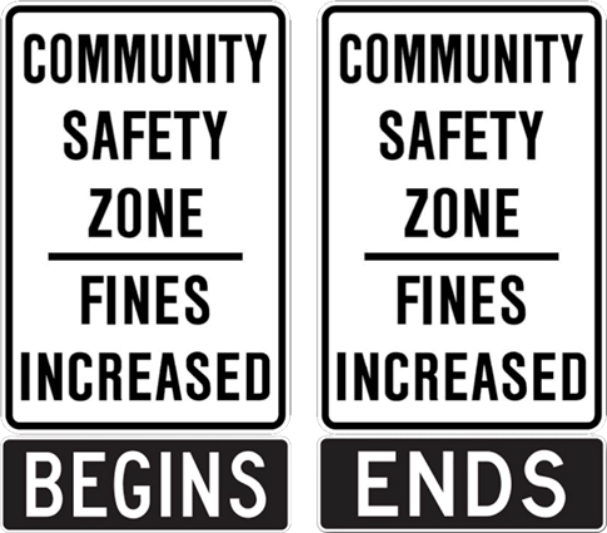
Community Safety Zones are designated areas where vulnerable road users, such as children, seniors, pedestrians and cyclists, may be present.
These zones are established through municipal by-laws and are designed to encourage safer driving behaviour through increased penalties for traffic violations.
Community Safety Zones can help:
- Create safer environments near schools, parks and community centres
- Encourage compliance with posted speed limits
- Deter speeding and careless driving
- Reduce the risk of collisions and injuries
While the rules of the road remain the same, fines for certain traffic offences can be increased within designated Community Safety Zones.
- Obey posted speed limits, especially in school zones and Community Safety Zones. Adjust your speed to road and weather conditions and always drive safely.
- Don’t drive distracted, keep your eyes on the road and your hands on the wheel. Never talk, text or email using a handheld device while driving.
- Be crosswalk smart and watch for pedestrians, especially children and crossing guards near schools. Wait for pedestrians to completely clear the roadway before driving.
- Arrive alive and never drive under the influence of alcohol or drugs. Always drive sober and drive safe.
Community Safety Zone locations
Partnerships that support road safety
Creating safer roads requires collaboration between many organizations.
Halton Region works with local municipalities, neighbouring road authorities, the Province of Ontario, police services, school boards, transit agencies and community organizations to coordinate road safety initiatives and improvements across the region.
We also work alongside the Halton Regional Police Service (external link)to support road safety education and awareness initiatives.
While Halton Region is responsible for planning, designing and maintaining Regional roads, traffic law enforcement is the responsibility of police services.
Police enforcement activities may include:
- Speeding
- Distracted driving
- Impaired driving
- Seatbelt compliance
- Aggressive driving
- Community Safety Zone enforcement
- Other Highway Traffic Act offences
Resources and road safety education
Explore additional resources, guides, videos, maps and educational materials to help you travel safely on Regional roads.