
Roundabouts are becoming a familiar sight on roads across Halton, but they're also one of the road features residents ask about most often. From choosing the correct lane to knowing when to yield, many people want to make sure they're navigating them safely and correctly.
The good news is that roundabouts are designed to make intersections safer and traffic flow more smoothly. Whether you're behind the wheel, on a bike or crossing as a pedestrian, understanding a few simple rules can help you use roundabouts with confidence and keep everyone moving safely.
What is a U-turn and where can you make one in Halton?
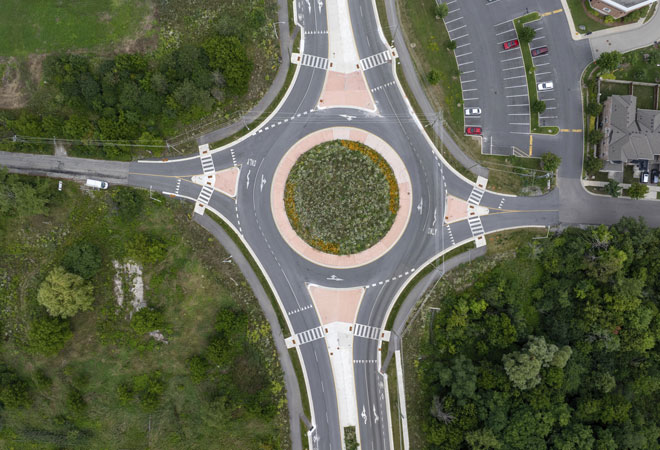
A roundabout is a circular intersection designed for traffic to move continuously in a counter-clockwise direction. Unlike traditional intersections, there are no traffic lights or stop signs at a roundabout.
- Improved safety.
Roundabouts have fewer conflict points between vehicles and slower driving speeds to help decrease the risk of serious collisions. - Better efficiency.
With fewer stops and less delays than a traffic light or stop sign, roundabouts allow high volumes of traffic to travel through the area. - Reduced environmental impact.
Roundabouts eliminate maintenance and electricity costs associated with traffic signals. Fewer delays also help reduce the level of fuel consumption and car emissions.
Driving through a roundabout: 5 tips for a safe trip
Roundabouts work best when all road users understand how to navigate them safely. Keep these five tips in mind the next time you approach a roundabout.
- Slow down and stay alert.
As you approach, reduce your speed, follow the posted signs and lane markings, and watch for pedestrians, cyclists and other vehicles. Keep in mind the following:- Yield to pedestrians at crosswalks and wait until they have crossed safely before proceeding.
- Watch for cyclists and treat them as you would any other vehicle in the roundabout.
- Give large vehicles, such as buses and transport trucks, extra space as they may need to use both lanes.
- If an emergency vehicle is approaching, do not stop inside the roundabout. Exit when it is safe to do so, then pull over and allow the vehicle to pass.
- Choose the correct lane before entering.
Choose the lane that matches your intended exit before entering the roundabout.- Right lane: Turn right or continue straight.
- Left lane: Turn left or continue straight.
- Yield to traffic already in the roundabout.
- Vehicles circulating within the roundabout have the right-of-way.
- Wait for a safe gap in traffic before entering and avoid driving beside another vehicle already travelling through the roundabout, as they may be preparing to exit.
- Keep moving once you’re in
- Travel counter-clockwise around the central island and continue moving through the roundabout.
- Avoid stopping unless necessary to prevent a collision. Traffic entering the roundabout must yield to vehicles already inside.
- Signal before you exit
- After passing the exit immediately before yours, activate your right-turn signal to let other road users know you are leaving the roundabout.
- As you exit, watch for pedestrians at the crossing and be aware of vehicles travelling in adjacent lanes.
Roundabout safety tips for cyclists and pedestrians
If you're a cyclist using a roundabout, make sure to:
- Ride as if you were driving a vehicle. Take your place in the travel lane and follow the same rules as vehicles using the roundabout. Make sure to safely merge into the travel lane before a bike lane or shoulder ends.
- Ride in the centre of your lane; do not hug the curb of a roundabout.
- Use hand signals. Always communicate your intentions, using clear hand signals to indicate when you are exiting the roundabout.
- Walk if you are uncomfortable. If you do not feel comfortable cycling through a roundabout, dismount and use the roundabout as a pedestrian would.
If you're a pedestrian using a roundabout, make sure to:
- Use the crosswalks. Walk to the nearest crosswalk and cross only at marked pedestrian crossings. Never cross through the middle of a roundabout.
- Stop and make yourself visible. Pause at the curb, check for approaching vehicles, and clearly indicate your intentions to cross by pointing or making eye contact with drivers.
- Wait for vehicles to stop. Do not enter the crosswalk until vehicles have slowed down and stopped for you to cross.
- Use the splitter island. If needed, use the splitter island in the centre of the roadway before continuing to cross.
Roundabouts and Regional Roads
As our community continues to grow, roundabouts are becoming a more common feature on Regional roads to improve traffic flow, reduce congestion and enhance safety for all road users.
To help ensure roundabouts continue to operate safely and efficiently, Regional staff regularly monitor their performance across our road network. Advisory speed limits are posted in advance of every roundabout entrance to help drivers adjust their speed to enter, circulate and exit a roundabout safely.
There are 11 roundabout locations throughout Halton Region. View our Google Map to see exactly where they are (Google Maps link).
Learn more!
Know the road – because safer driving starts with you! For more information about road safety, you can: