
Advocating for a Strong Halton

Advocating for residents
We advocate on behalf of the more than 666,000 residents living in Burlington, Halton Hills, Milton and Oakville. We work with all levels of government to secure key investments and inform legislative and policy changes to meet the needs of the Halton community and keep Halton a great place to live, work, raise a family and retire.
Working together with the Provincial Government
Halton Region continues to build a strong partnership with the Provincial Government. A collaborative partnership remains critical as we continue to work together to advance the following priority issues impacting the Halton community.
High market rental costs, static social assistance programs and the growing mental health and addictions crisis are increasing the demand for homelessness services and supports across Halton. Municipal governments, including Halton Region, are often the first point of contact for people facing struggles with mental health and addictions, many of whom require intensive supports and experience challenges with securing and maintaining stable housing.
There is also significant demand for dedicated supportive and assisted housing across Halton for individuals and families unable to afford market rent. All 5,608 existing assisted housing units in the Region are fully occupied, with 8,581 households on the wait list. At current rates, only 9% of Halton’s existing waitlist will be housed each year. Unmet demand in the community continues to put increased pressure on the Region’s emergency shelter system.
Research from the Association of Municipalities of Ontario (AMO), in partnership with the Ontario Municipal Social Services Association (OMSSA) and the Northern Ontario Service Deliverers Association (NOSDA) (PDF file) has found that more than 85,000 Ontarians experienced homelessness in 2025, a number that has grown by more than 50% since 2021. In Halton, there has been a 185% increase in unsheltered homelessness since 2018 and the Region’s emergency shelter system is currently operating at 140% capacity.
Halton Region has identified 658 shovel-ready assisted and supportive housing units, contingent on Provincial and Federal funding opportunities to begin construction. Halton Region’s Portfolio of housing opportunities (PDF file) provides an overview of Halton’s shovel-ready and in progress projects. These new units are critical in preventing higher emergency shelter use, street homelessness and encampments.
The Provincial government can support Halton in providing housing for those with the greatest need by:
- Increasing Homelessness Prevention Program (HPP) funding.
- Increasing social assistance rates and providing greater flexibility to improve housing stability outcomes.
- Increasing coordination across all three levels of government including key provincial ministries and agencies (MMAH, MCCSS, Ontario Health) to address the homelessness, income security, mental health and addictions crises.
- Providing dedicated operating funding for new supportive housing units.
- Working with the Federal Government on the renewal of the National Housing Strategy to ensure the continued flow of funding to enable municipalities, including Halton, to increase the supply of assisted and supportive housing, preserve existing housing stock and deliver affordability supports.
- Partnering with us to get our shovel-ready assisted and supportive housing properties built faster including committing funding to help advance our projects submitted to Build Canada Homes.
Provincial Government: Providing Housing for those with the Greatest Need (PDF file)
Halton and the Provincial Government share the costs of critical health and social services including public health, paramedic services, employment and social services, and services for seniors. The current Provincial funding received for these critical services delivered by the Region has not kept pace with population growth, increasing demand and inflation. The amount the Region funds over and above Provincial cost-share models is increasing by $1.7 million to a total of $18.5 million in the 2026 Budget. It is not sustainable for property taxpayers in Halton to continue funding the increasing costs for critical health and social services without the Provincial Government contributing its intended share.
Development charges are a key source of financing for Halton Region’s growth-related infrastructure. The Development Charges Act, 1997 (DCA), limits the recovery of growth-related costs from new development and creates uncertainty in funding the critical infrastructure needed to support growth. In Halton, the total estimated funding gap under the DCA versus the “growth pays for growth” principle is currently $20.5 million. The impacts of many of the recent legislative changes to the DCA are unknown at this time. Without alternate sources of funding, the changes to the DCA may impact the timing of the delivery of the housing-enabling infrastructure needed to support growth and/or could have a significant negative impact on existing tax and rate payers.
Fiscal responsibility is a key driver for Halton, with the Region consistently maintaining top credit ratings from S&P Global Ratings (AAA) since 2002 and Moody’s Investors Service (Aaa) since 1989 while keeping tax increases below the rate of inflation.
In 2026, 6.2% of Halton’s total property taxes collected will be used to cover Provincial funding shortfalls for health and social services and limitations on DC revenues. Municipalities have limited revenue tools available and any increase in financial need translates into an increase in property taxes, utility rates and user fees, which many households cannot afford. Unlike Provincial and Federal taxes, property taxes are not tied to income.
Provincial funding shortfalls
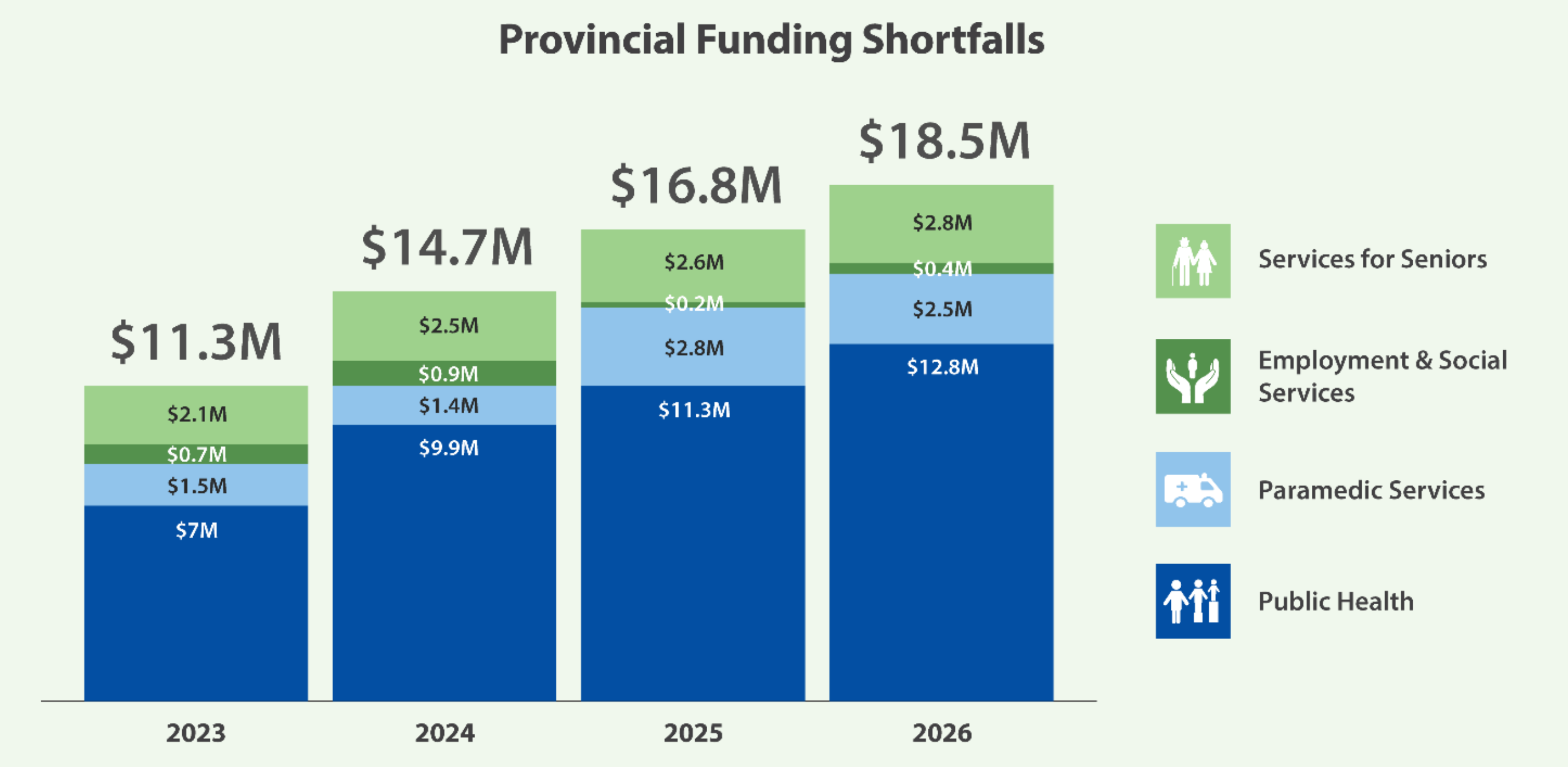
2023 budget: $11.3M
- Services for Seniors: $2.1M
- Employment & Social Services: $0.7M
- Paramedic Services: $1.5M
- Public Health: $7.0M
2024 budget: $14.7M
- Services for Seniors: $2.5M
- Employment & Social Services: $0.9M
- Paramedic Services: $1.4M
- Public Health: $9.9M
2025 budget: $16.8M
- Services for Seniors: $2.6M
- Employment & Social Services: $0.2M
- Paramedic Services: $2.8M
- Public Health: $11.3M
2026 budget: $18.5M
- Services for Seniors: $2.8M
- Employment & Social Services: $0.4M
- Paramedic Services: $2.5M
- Public Health: $12.8M
A review of the municipal fiscal framework is required to ensure that municipalities are better positioned to champion the Province’s priorities and address pressing community challenges. Halton Region supports the Federation of Canadian Municipalities’ (FCM) calls for a National Prosperity Partnership and the Association of Municipalities of Ontario’s (AMO) calls for a comprehensive social and economic prosperity review to ensure municipalities can continue to address the priority issues affecting communities.
The Provincial Government can support Halton in reducing Regional contributions for Provincial funding shortfalls by:
- Increasing the Provincial funding allocation by $18.5 million for cost-shared programs in health and social services and ensuring Provincial funding keeps pace with inflation and growth.
- Working with the Region to explore alternative sources of funding to finance growth-related infrastructure, that does not impact property tax and rate payers.
- Participating in further discussions with the Federation of Canadian Municipalities on the potential for a National Prosperity Partnership and the Association of Municipalities of Ontario as part of the call for a Provincial Social and Economic Prosperity Review.
As one of the fastest growing communities in the country, Halton Region is facing significant demand for Canada Wide Early Learning and Child Care (CWELCC) spaces. Demand from Halton families and child care operators is expected to continue as the community grows.
Up to 3,000 Halton families are unable to access CWELCC spaces. This creates barriers to education and employment for parents/caregivers and limits the Region’s economic competitiveness. To address this significant and growing demand for CWELCC spaces in Halton, it is critical that the Provincial Government reassess Halton’s space allocation and revise the methodology used to allocate CWELCC spaces to more accurately reflect community need. Provincial investment would allow Halton to expand CWELCC spaces to respond to community need, prevent long wait-times for affordable child care, and ease financial hardship for families.
The Provincial Government can support Halton in delivering high quality and affordable child care by:
- Providing new CWELCC spaces to support the 3,000 Halton families unable to access affordable child care.
- Revising the methodology used to allocate CWELCC spaces to better reflect current and future community need.
- Working with the Federal Government to execute a multi-year bilateral agreement which stabilizes the CWELCC system, increases affordability and supports continued system growth.
- Restoring local flexibility to the Local Priorities Fund.
Provincial Government: Expanding Affordable Child Care Spaces to Meet Demand (PDF file)
Working together with the Federal Government
Halton Region continues to build a strong partnership with the Federal Government. A collaborative partnership remains critical as we continue to work together to advance the following priority issues impacting the Halton community.
High market rental costs and the growing mental health and addictions crisis are significantly increasing the demand for homelessness services and supports, including emergency shelter. Municipal governments, including Halton, are often the first point of contact for people facing struggles with mental health and addictions, many of whom require intensive supports, and experience challenges with securing and maintaining stable housing.
The demand for homelessness supports and service across Halton continues to exceed available supply. The Region’s emergency shelter system is currently operating at 140% capacity, and there is a significant demand for assisted housing for individuals and families unable to afford market rent. All 5,608 existing assisted housing units in the Region are fully occupied, and 8,581 households are on the wait list. At the current rate, only 9% of Halton’s existing waitlist will be housed each year. This data points to a clear call for increased, long-term and predictable funding from the Federal Government to meet demand and make long-term strategic investments in homelessness prevention and supportive housing.
This data points to a clear call for increased, long-term and predictable funding from the Federal Government to meet demand and make long-term strategic investments in homelessness prevention and supportive housing.
The Region currently has 658 shovel-ready assisted and supportive housing units (PDF file) in its portfolio of housing development opportunities. This means they are fully zoned and serviced, and ready for Federal and Provincial investment to get construction started. These new units are critical in preventing higher emergency shelter use, street homelessness and encampments.
The Federal Government can support Halton in providing housing for those with the greatest need by:
- Providing increased, long-term and predictable capital and operating funding to support individuals and families who are homeless or at risk of homelessness with stable and affordable housing, including increasing funding provided through the Reaching Home and making the program permanent.
- Working with the Provincial Government on the renewal of the National Housing Strategy to ensure the continued flow of funding to enable municipalities, including Halton, to increase the supply of assisted and supportive housing, preserve existing housing stock and deliver affordability supports.
- Increasing coordination across all three levels of government to address the homelessness, mental health and addictions crises, including increasing collaboration with the Ontario Ministry of Health to fund new supportive housing units.
- Partnering with us to get our shovel-ready assisted and supportive housing properties built faster including partnering to deliver our portfolio of projects submitted to Build Canada Homes.
Federal Government: Providing Housing for Those with the Greatest Need (PDF file)
The Region, its residents and businesses continue to be impacted by severe weather events such as floods, high winds, tornadoes, ice storms and extreme heat and cold days. These events pose serious risks to the Region’s infrastructure including watermains and wastewater pumping stations and threaten the health, safety and quality of life of residents.
In July 2024, Halton Region experienced five consecutive intense rainfall events, resulting in 100 to 220 mm of total rainfall in isolated areas throughout the region contributing to 1,897 basement flooding incidents. Of the reported flooding, roughly 54 per cent were related to the stormwater-induced wastewater system surcharges, with the remainder being directly flooded by stormwater.
As outlined by FCM, municipalities build and maintain 60% of the core public infrastructure that supports communities including water, wastewater and roads. Long-term predictable sources of funding are required from the Provincial and Federal Governments to invest in climate action, including aging infrastructure and adaptation measures for communities.
The Federal Government can help address climate change and support a resilient Halton community by:
- Providing long-term, sustainable funding for municipal climate adaptation efforts to support resilient communities.
- Expanding federal funding programs such as the Disaster Mitigation and Adaptation Fund with dedicated streams for natural infrastructure, flood resilience, extreme heat mitigation and climate-resilient municipal infrastructure.
- Increasing direct municipal access to climate adaptation, resilience, and emissions reduction funding through programs such as FCM's Green Municipal Fund, to help strengthen community and corporate resilience, reduce climate risks, enhance biodiversity, and accelerate progress toward net-zero emissions.
Federal Government: Addressing Climate Change and Supporting Resilient Communities (PDF file)
The Canada Wide Early Learning and Child Care (CWELCC) program is saving families across Canada up to $11,255 per child annually, with approximately 18,940 families across Halton benefitting from these substantial cost reductions. These savings are critical for Halton families who are struggling with high mortgage rates/rental costs and other rising household expenses. A renewal of the Canada-Ontario CWELCC agreement beyond 2027 is essential to ensure that Halton families can continue to access affordable and high quality child care and benefit from the significant economic advantages it provides.
As one of the fastest growing communities in the country, Halton Region is facing significant demand for CWELCC spaces. Demand from Halton families and child care operators is expected to continue as the community grows. It is critical that any renewal of the bilateral CWELCC agreement include a commitment to improving affordability and continued system expansion to help meet growing demand in Halton and communities across Ontario.
The Federal Government can support Halton in expanding affordable and high quality child care by:
- Working with the Provincial Government to urgently renew the Canada-Ontario CWELCC agreement beyond 2027.
- Ensuring that the renewal of the Canada-Ontario CWELCC agreement:
- sustains progress made to date;
- increases affordability for parents; and
- builds a more sustainable system, with sufficient funding and flexibility to support continued system expansion to meet growing demand.
Federal Government: Expanding Affordable Child Care to Meet Demand (PDF file)
Regional programs and services
Get the facts
- Halton Region serves more than 666,000 residents across the City of Burlington, the Town of Halton Hills, Town of Milton, and the Town of Oakville.
- Halton is one of the fastest growing communities in Canada expected to grow to a population of over 1.1 million by 2051.
- With a growth rate of 8.8% between 2016 and 2021, Halton has seen the highest rate of growth across all upper- and single-tier municipalities in the GTHA.
- The Region is an effective upper-tier government responsible for delivering essential programs and services for the community, including providing high-quality drinking water, building housing-enabling infrastructure, delivering homelessness supports, operating long-term care homes, and administering public health and paramedic services.
- Welcome to Halton Region (YouTube video link)